


“As optometrists, we know when to refer for pathology, but how do we counsel patients with cosmetic ocular concerns?” asked Damaris Raymondi, OD, in the lecture she presented with Justin Karlin, MD, an oculoplastic specialist, at the 2026 meeting of the American Academy of Optometry. "Optometrists are the first stop for any eyelid and under-eye questions, and at times a cosmetic complaint can hide a real disease," said Dr. Raymondi.
Drs. Raymondi and Karlin reviewed simple exam techniques that do not require special techniques, such as using a penlight, measuring margin reflex distance (MRD) 1 and MRD 2, and taking photo documentation of patient complaints. Dr. Raymondi also stressed the importance of referring the patient's concerns to the oculoplastic surgeon so the surgeon can best determine whether one or a combination of procedures is needed.

The presenters also discussed 3 common causes of under-eye bags—fat, hollow, and fluid—how to identify them, and the approach to take for each. For fat, they said to look for a convex bulge; then a retropulsion test can be performed. If fat is the primary cause, a surgical referral may be appropriate. A hollow can be identified as a concave trough. A shadow in light test can be performed, and in these cases, restoring volume may be discussed. Fluid-related bags look boggy and puffy, may pit with pressure, and are often worse in the morning because fluid can accumulate while lying down. When fluid is suspected, it’s important to identify the cause first, they said (Figure 1).
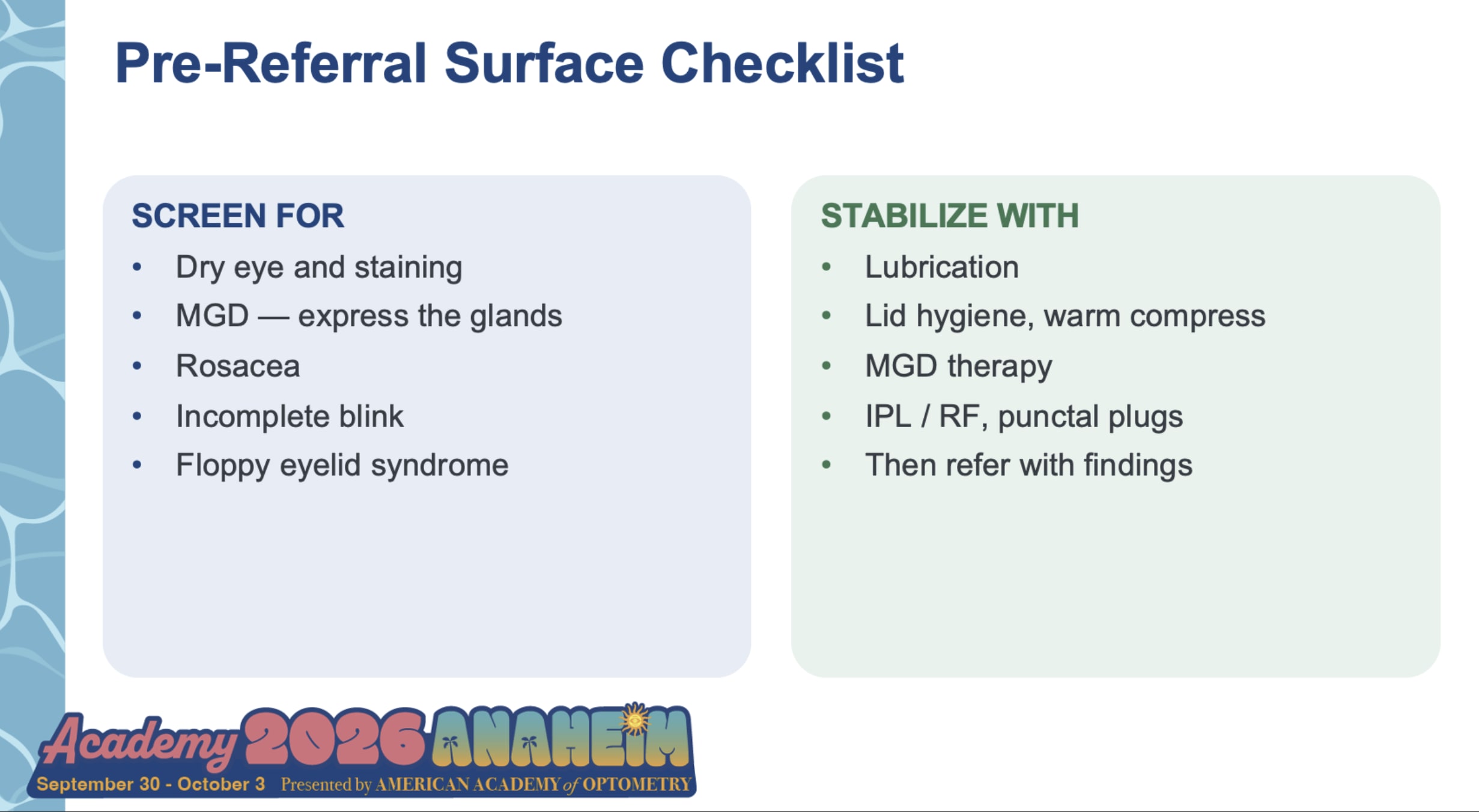
Drs. Raymondi and Karlin also provided a prereferral surface checklist that ODs can refer to if a patient is interested in pursuing cosmetic oculoplastic surgery. They advised to screen for dry eye and staining, meibomian gland dysfunction—express the glands, rosacea, incomplete blink, and floppy eyelid syndrome. They also recommended to stabilize with lubrication, lid hygiene, warm compresses, meibomian gland dysfunction therapy, intense pulsed light radio frequency, punctal plugs, and then refer with findings (Figure 2).
“As ODs, we need to properly guide our patients because our input can help surgeons achieve even better outcomes,” said Dr. Raymondi. “By combining the ODs understanding of the patient’s ongoing eye care with the surgeon’s surgical expertise, we can provide a more complete approach to care. It’s two specialties working together for one periocular patient.” OM