


When it comes to treating presbyopia, "topicals are an important option for our patients to have because they allow an additional option for temporary freedom from other forms of correction, such as not having to take your reading glasses out when dining out," said Jason S. Ng, OD, PhD, FAAO, in his presentation at the 2026 meeting of the American Academy of Optometry. “Having multiple options in this space allows for customization of the visual experience.”
Dr. Ng then provided an overview that applies to all presbyopia topicals and presbyopia in general. He began by discussing the importance of having patients use more light—higher illuminance or luminance levels. "Because more light already reduces pupil size, increases depth of field, and improves all general vision function—visual acuity, contrast sensitivity, reading speed, etc. because of the gains in the neural signals,” he said. Dr. Ng noted that increasingly smaller pupils can impact the extent of the visual field, as well as the perception of floaters. "So patients are not ideal candidates if they already have a lot of complaints of vitreous floater, for example," he explained.
Efficacy Data
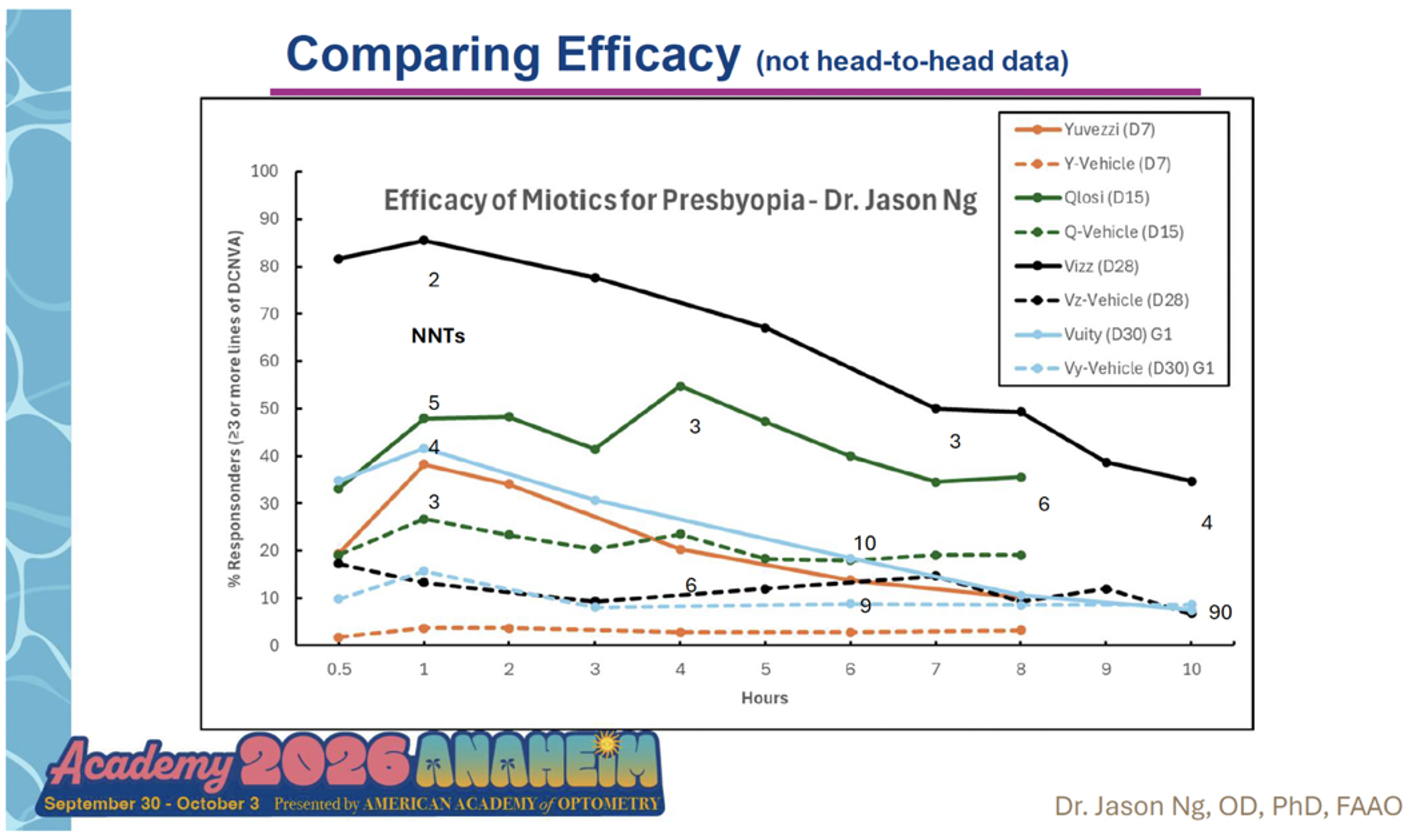
Dr. Ng then reviewed efficacy data (not head-to-head data) from the phase 3 trials for pilocarpine 0.4% (Qlosi; Orasis Pharmaceuticals); aceclidine ophthalmic solution 1.44% (Vizz; Lenz Therapeutics); carbachol and brimonidine tartrate ophthalmic solution 2.75%/0.1% (Yuvezzi; Tenpoint Therapeutics, Ltd.); pilocarpine hydrochloride ophthalmic solution 1.25% (Vuity; AbbVie, which has been discontinued); and MR-141 (phentolamine ophthalmic solution 0.75%), from Viatris, which the US Food and Drug Administration (FDA) has assigned a PDUFA goal date of October 17, 2026 (Figure 1).
“Just looking at the efficacy ratios, both 0.4% pilocarpine and phentolamine are similar, and Vizz and Yuvezzi are similar,” he pointed out. “Depending on the patient’s needs, short or long duration, and stronger effect (moderate-severe presbyopia) vs weaker effect (mild-moderate presbyopia), as well as the side effect profile, doctors can recommend what would work best for a given patient. With Qlosi having higher control responder rates and Yuvezzi having the lowest responder rates, the responder rates amongst the treatment group may be more important to consider for a given patient.”
Side Effect Profiles
Next, Dr. Ng compared side effect profiles (Figure 2), noting that “Qlosi has the least side effects, Vizz seems to have the most, and Yuvezzi is somewhere in the middle. Because phentolamine is dosed at night, the patient may have few side effects because most side effects would be over by the time they wake up.”
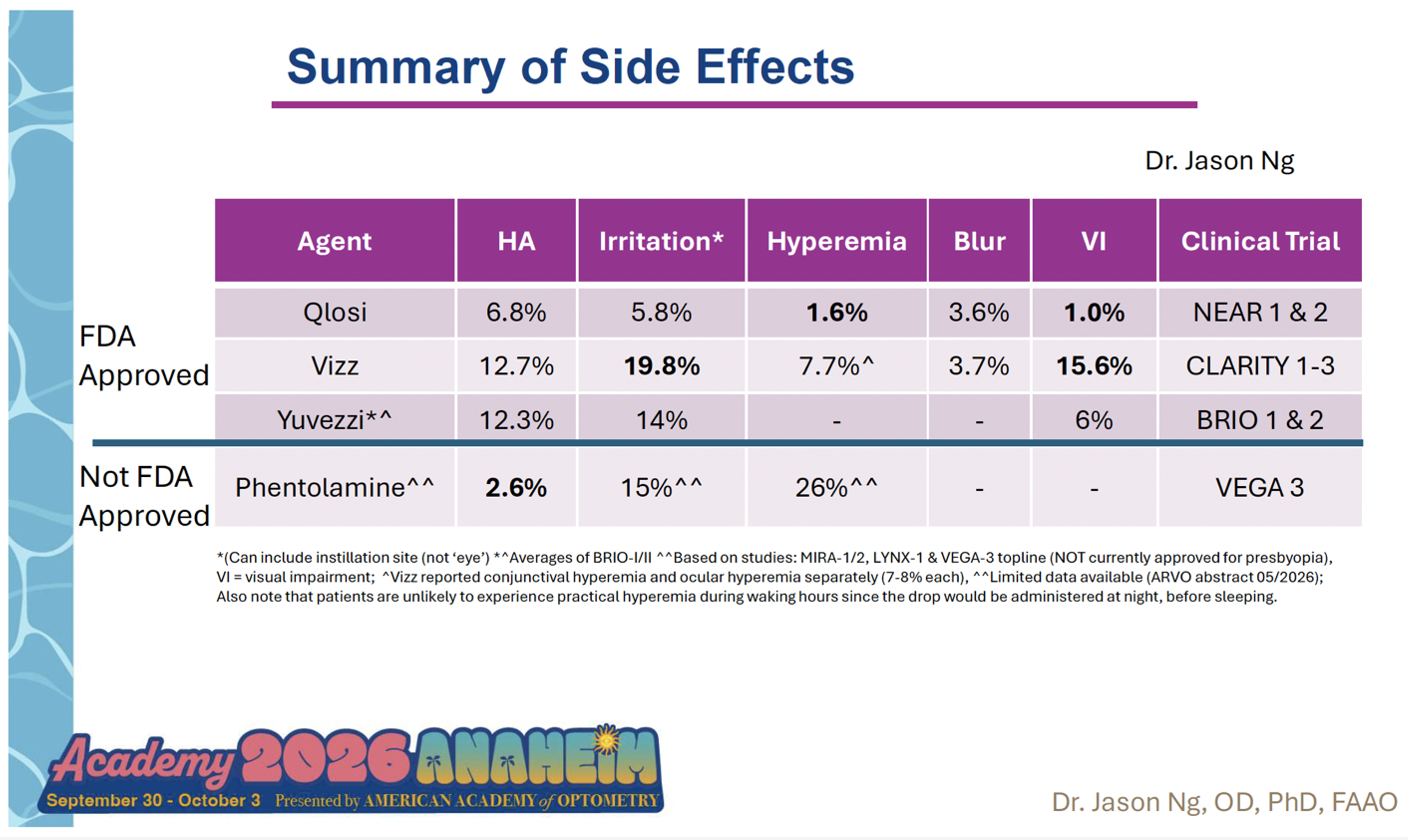
An important point to note, said Dr. Ng, “is that Yuvezzi was released in March 2026, so optometrists don't have much clinical experience with it yet, and with phentolamine potentially receiving FDA approval this year, this makes the space somewhat crowded. Optometrists will need to understand the nuances of each drop to decide on the best treatment for a particular patient.”
Dr. Ng provided a summary table comparing all of the presbyopia topicals (Figure 3).
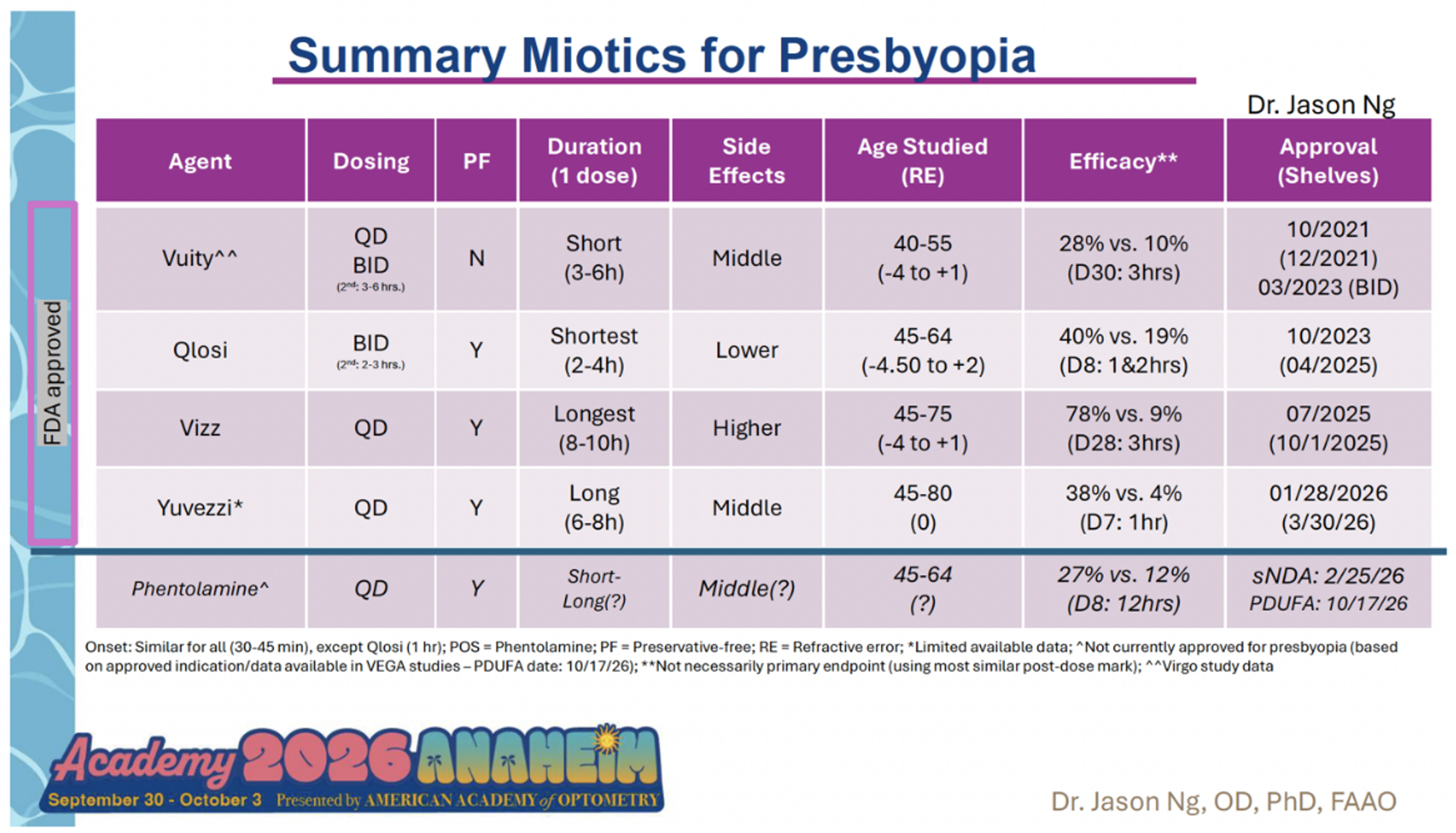
Dr. Ng ended his presentation with some clinical pearls for patient selection and use. He said that "selecting patients with low to moderate amounts of refractive error and presbyopia are going to provide the most early success. Also, ensuring anterior and posterior segment health before prescribing these topicals is critical. Lastly, informing the patient that the side effects are going to be the worst in the first few days, but that they get much less with continued use is important for patients to understand."
He summed it up in general as: The first dose will tell the patient if it’s going to work, the first week will give the patient a good idea of tolerability and durability, and the first month can determine long-term viability for their lifestyle.
“While this new generation of miotics are best as supplements to presbyopia management, they can in fact help patients maintain and/or improve their habitual situation,” Dr. Ng concluded. “For example, patients with low hyperopia, pseudophakia, postrefractive surgery, and contact lens users (single vision and multifocal) can all benefit.” OM