

Welcome to The Coding Corner, a space where doctors who are already excellent at doctoring can dig into the finer details of coding, documentation, compliance, and the occasional mystery that is the AMA Evaluation and Management (E/M) grid. This month, Tonya Reynoldson, OD, and Sarah Haney discuss the nuances of billing for new technology.
Tonya: Sarah, it seems like every year there’s another exciting technology entering the optometric market. Many companies provide practices with coding information and even estimate how many procedures it takes to pay for the instrument. Is there anything wrong with that approach?
Sarah: Not necessarily. Industry representatives are often excellent resources for understanding what new technology does and how it may improve patient care. The challenge is remembering that manufacturers don’t determine reimbursement; payors do.
Whenever you receive coding guidance, ask yourself an important question: “Could I defend billing for this service during an audit?”
CPT tells us what code to use to report a service, but it doesn’t determine whether an insurance company will pay for it. Every payor publishes its own coverage policies that define when a service is considered medically necessary, investigational, or noncovered. If you’re contracted with that payor (ie, in network), you’re contractually obligated to follow those policies.
My advice? Recognize the coding decision tree:
- CPT provides the codes and definitions for the services we report, but it does not determine whether a payor will cover them.
- Coverage for each service is established by each payor’s published medical policies.
- Not every payor follows the same rules.
Know where your coding guidance came from and which payor policy supports it, plus keep those references readily available. Strong references, paired with excellent medical record documentation, may help you win an appeal, but published payor policies are the standard you’ll ultimately be measured against.
Tonya: Sometimes doctors hear statements like, “You only need to perform 20 tests a month to pay for this instrument.” From a coding perspective, what’s the danger in thinking about technology that way?
Sarah: That statement always makes the auditor in me pause. Purchasing new technology should never encourage or inappropriately inflate testing usage. The number of diagnostic tests you perform should be driven by your patients’ clinical needs, not by ownership of the equipment or the desire to recover the investment.
If I were advising a practice owner, I’d walk through 5 questions before investing in any new technology:
General Investigation
1. What does this technology actually do? How will it improve patient care?
2. What conditions does it help diagnose, evaluate, or manage? Make sure the technology aligns with the diseases you commonly treat.
Do Your Own Math
3. Do I actually have the patient population to support this technology? Run a report from your EHR. How many patients with those diagnoses did you see over the past 12 months?
4. Of those patients, how many would have truly met medical necessity? As we discussed in August 2026’s Coding Corner, covered diagnoses and medical necessity are not the same thing. A patient may have a covered condition and still not require the test.
5. Does the investment make financial sense? Based on your own patient population and chart review, not a marketing estimate, how many patients would have genuinely benefited from the technology over the past year?
When clinical need drives purchasing decisions, compliance usually follows naturally.
Tonya: Can you explain the differences between:
• A test that is clinically useful
• A test that is medically necessary
• A test that is reimbursable
I think doctors sometimes confound them.
Sarah: This is one of my favorite topics because they’re all related but aren’t interchangeable.
To me, clinically useful means the technology provides valuable information that may improve patient care. Many outstanding technologies fall into this category, even when insurance doesn’t cover them.
Medically necessary has 2 practical definitions that providers should understand.
- From a clinical perspective, it means the provider determined the test is needed to evaluate, diagnose, treat, or manage the patient’s condition based on that patient’s individual presentation.
- From the payor’s perspective, medical necessity means the service also meets the payor’s published covered indications, documentation requirements, and coverage guidelines.
Both definitions matter. A provider may appropriately determine a test is clinically necessary, but if it doesn’t meet the payor’s coverage criteria, the service may not be reimbursable.
Reimbursable means the service meets the payor’s coverage policy, their specific medical necessity requirements, and billing rules.
Think of these categories as 3 overlapping circles, not one giant circle.
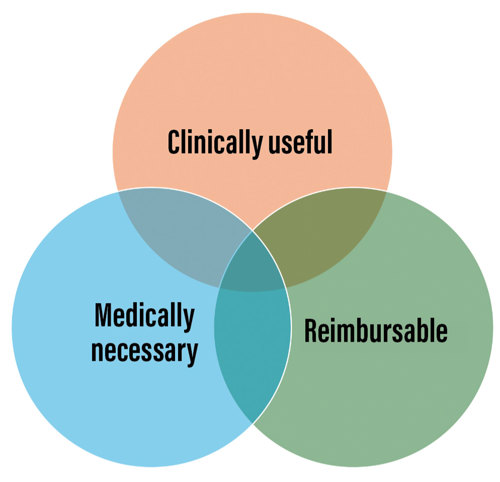
- Some services are all 3.
- Some are clinically useful and the provider feels they are medically necessary, but they aren’t covered by the patient’s insurance.
- Others may be listed as covered services but they aren’t medically necessary for the patient sitting in your chair today.
Tonya: We’ve also seen reimbursement for certain technologies decline over time. Does decreasing reimbursement ever change the definition of medical necessity?
Sarah: No. Medical necessity has never been based on reimbursement. In fact, some reimbursement changes have nothing to do with the clinical value of a service. For example, CMS recently finalized an Efficiency Adjustment within the Medicare Physician Fee Schedule for certain non-time-based services. The premise is that, as technology advances and workflows become more efficient, some services require less physician work and fewer resources than when they were originally valued. As a result, CMS has decreased reimbursement to what they understand better reflects today’s practice environment.
That’s an important distinction: A change in reimbursement does not change when a test is clinically appropriate or medically necessary.
The clinical question should always remain the same: “Based on my examination findings, will this test aid in diagnosing, evaluating, treating, or managing my patient’s condition?”
If the answer is yes, perform the test and document your clinical reasoning.
If the answer is no, reimbursement should never influence the decision to order the service.
Tonya: If you could leave doctors with 1 principle about medical necessity, what would it be?
Sarah: I’d keep it simple. Don’t let the technology and potential reimbursement decide who gets tested. Every diagnostic test should answer a clinical question that arose during the examination. If you can clearly explain why this patient needed this test today and your documentation tells that story, you’ve already put yourself on the path toward compliant coding.
If that judgment is based on financial goals instead of clinical need, you’ve shifted away from patient-centered care and into an area that auditors and government agencies scrutinize very closely (see the resources section for a recent OIG case on billing for unnecessary OCTs and fundus photos).
Technology is one of the greatest gifts we’ve been given in modern optometry. It helps us diagnose disease earlier, manage patients more effectively, and improve outcomes every day. But remember: The technology supports and aids your clinical judgment; it should never replace it.
Until next time when we talk about T and S codes, the newest technology doesn’t change the oldest rule: medical necessity comes first.OM
Resources
- The Coding Corner: Screening vs Diagnostic Testing https://www.optometricmanagement.com/issues/2026/july-august/the-coding-corner-screening-vs-diagnostic-testing/
- Aetna Clinical Policy Bulletin 0854 – Multifocal Electroretinography (mfERG) https://www.aetna.com/cpb/medical/data/800_899/0854.html
- Centers for Medicare & Medicaid Services (CMS) – Local Coverage Determination (LCD): Electroretinography (ERG) (L38992) https://www.cms.gov/medicare-coverage-database/view/lcd.aspx?lcdId=38992&ver=14
- Centers for Medicare & Medicaid Services (CMS) – Billing and Coding Article: Electroretinography (ERG) (A58706) https://www.cms.gov/medicare-coverage-database/view/article.aspx?articleid=58706&ver=12
- Centers for Medicare & Medicaid Services (CMS) – Billing and Coding Article: Fundus Photography (A58706) https://www.cms.gov/medicare-coverage-database/view/article.aspx?articleid=58706&ver=12
- US Department of Justice – Conyers Doctor Agrees to Pay $1.85 Million to Resolve Allegations of Medically Unnecessary Testing https://media.defense.gov/2023/Jan/11/2003143421/-1/-1/1/230109-CONYERS%20DOCTOR%20PAYS%20$1,850,000.PDF