

The clinical cause of contact lens intolerance can be frustrating to pinpoint in clinical practice. Patients may complain of reduced wear time or increased foreign body sensation, burning, itching, and fluctuating vision before they completely stop wearing their lenses.1
Studies have indicated that 93% of soft contact lens dropout patients also suffer from an infestation of Demodex mites,2 and less than 6% of patients with Demodex present on their lid margins do not report any discomfort or irritation with their contact lens wear.3
Further, 57% of patients with meibomian gland dysfunction (MGD) also have Demodex blepharitis.4 The presence of Demodex mites can have a significant influence on the biofilm that accumulates on the lid margins, and Demodex chitin and metabolites lead to an increase in immune response, which releases proteins into the tear film.5 These proteins deposit on the lenses and lead to complications, such as mechanical irritation, papillary conjunctivitis, and perceived discomfort. The end result can be contact lens dropout.6
What Role Does MGD Play?
MGD is shown to be present in about 60% of contact lens wearers.7 These patients are more likely to have abnormal meibum, conjunctival hyperemia, lid margin telangiectasia, and clogged meibomian glands.7 The correlation is even higher when looking at the relationship between MGD and contact lens discomfort or dropout.3
What Can We Do?
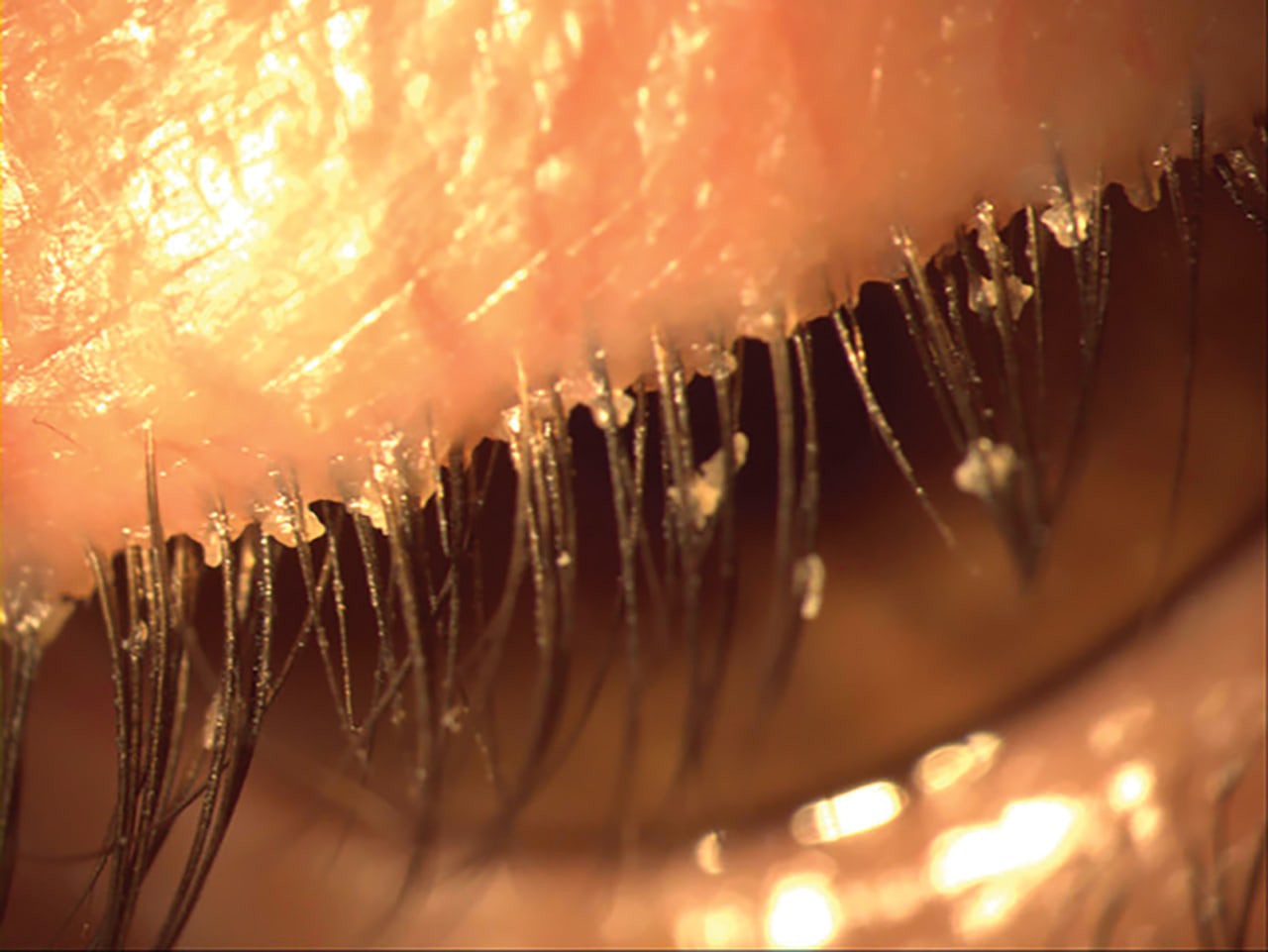
The presence of collarettes at the base of the eyelashes is pathognomonic for Demodex mites.4 This means it can be as simple as having the patient look down while in the slit lamp, increasing magnification, and examining the lid margins to make the diagnosis.
The presence of collarettes confirms the diagnosis of Demodex blepharitis, and the patient can be treated with a 6-week course of lotilaner 0.25% ophthalmic solution (Xdemvy; Tarsus). Xdemvy is the only FDA-approved medication to eradicate Demodex mites and is simple to administer. Lotilaner is a lipophilic solution that targets the lid margins and meibomian glands. The drop is instilled twice daily. Contact lens wearers should wait 15 minutes after intillation to apply their lenses. The medication paralyzes the mites and within 6 weeks, both adult mites and their offspring are eradicated.8 Clinical trials have also shown a 54% increase in meibomian glands yielding liquid secretions after a 6-week course of treatment with lotilaner.9
Compounded ivermectin cream is also available as an alternative to lotilaner drops. Ivermectin 1% cream applied to the lids of patients who have Demodex blepharitis for 15 minutes once a week has been shown to significantly improve symptoms, as well as reduce ocular surface staining, eyelid debris, redness/swelling, and telangiectasia.10 Ivermectin 1% is now readily available in combination with metronidazole 0.5% and tea tree oil 0.3% compounded by Primera Professional Pharmacy.
Conclusions
Contact lens dropout is not a new problem in our clinics. Understanding the relationship between healthy meibum and increased contact lens comfort is also not new. But treatment that effectively address the root cause of meibomian gland dysfunction is available for our patients who have dropped out of contact lens wear.OM
References
-
Markoulli M, Kolanu S. Contact lens wear and dry eyes: challenges and solutions. Clin Optom (Auckl). 2017;9:41-48. doi:10.2147/OPTO.S111130
-
Tarkowski W, Moneta-Wielgoś J, Młocicki D. Demodex sp. as a potential cause of the abandonment of soft contact lenses by their existing users. Biomed Res Int. 2015;2015:259109. doi:10.1155/2015/259109
-
Pucker AD, Jones-Jordan LA, Marx S, et al. Clinical factors associated with contact lens dropout. Cont Lens Anterior Eye. 2019;42(3):318-324. doi:10.1016/j.clae.2018.12.002
-
Trattler W, Karpecki P, Rapoport Y, et al. The prevalence of Demodex blepharitis in US eye care clinic patients as determined by collarettes: a pathognomonic sign. Clin Ophthalmol. 2022;16:1153-1164. doi:10.2147/OPTH.S354692
-
Baima B, Sticherling M. Demodicidosis revisited. Acta Derm Venereol. 2002;82(1):3–6. doi:10.1080/000155502753600795
-
Akilov OE, Mumcuoglu KY. Immune response in demodicosis. J Eur Acad Dermatol Venereol. 2004;18(4):440–444. doi:10.1111/j.1468-3083.2004.00964.x
-
Machalińska A, Zakrzewska A, Adamek B, et al. Comparison of morphological and functional meibomian gland characteristics between daily contact lens wearers and nonwearers. Cornea. 2015;34(9):1098-1104. doi:10.1097/ICO.0000000000000511
-
Gaddie IB, Donnenfeld ED, Karpecki P, et al. Lotilaner ophthalmic solution 0.25% for Demodex blepharitis: randomized, vehicle-controlled, multicenter, phase 3 trial (Saturn-2). Ophthalmology. 2023;130(10):1015-1023. doi:10.1016/j.ophtha.2023.05.030
-
Gupta PK, Gaddie IB, Shultz MC, et al. Effects of lotilaner ophthalmic solution, 0.25% on Demodex blepharitis patients with meibomian gland disease. Clin Ophthalmol. 2026;20:527753. doi:10.2147/OPTH.S527753
-
Choi Y, Eom Y, Yoon EG, Song JS, Kim I-H, Kim HM. Efficacy of topical ivermectin 1% in the treatment of Demodex blepharitis. Cornea. 2022;41(4):427-434. doi:10.1097/ICO.0000000000002802